
10 Propositions for Space Superiority

The application of the term space superiority has become frustratingly inconsistent within a military context. On one hand, the doctrinal definition in Joint Publication 3-14 relies on obscure statements like degree of control, freedom of access and action, and prohibitive interference while omitting any direct reference to military operations.[1] This phrasing creates a definition that is more confusing than practical. At the same time—and sometimes even in the same publications—the term space superiority has also been used to describe any scenario where one side’s space technology is superior to the other’s. For example, the paragraph in Joint Publication 3-14 immediately following the definition of space superiority makes the superficial claim that space superiority is the aggregate advantage of all the space mission areas. Given these conflicting descriptions, it is little wonder that U.S. Space Force leadership has launched a concerted effort to reclaim the meaning and application of the term space superiority.ii This paper builds on that work by anchoring the ends, ways, and means of space superiority within the context of military doctrine by proposing 10 propositions for counterspace operations. Taken together, these propositions imply that gaining and maintaining space superiority requires a component-led offensive operation that is sequenced to first secure the space domain by neutralizing adversary counterspace threats before pivoting to dismantle their space-enabled kill chains.
1. Space-enabled attack is the central focus of space superiority.
Is space superiority a temporary condition or an enduring outcome? Does the global nature of space operations preclude localized space superiority? What is space superiority measured and assessed against? These questions strike at the very heart of any space superiority framework and have been a mainstay of Guardian professional military education for over 20 years. Over the years, space superiority doctrine has shifted with contemporary policy on the weaponization of space, evolving from early concepts of space warfighting to a more defensive posture focused on mission assurance.[3] By 2012, Joint doctrine defined space superiority primarily as the ability to maintain our own freedom of action in space.[4] This emphasis on access, rather than on denying adversary use, overlooked the primary benefit of achieving space superiority in the first place.
Achieving space superiority is not a military end in itself; instead, it is only operationally useful if it enables accomplishment of military objectives across all domains. In this way, space superiority is no different from air superiority. In the classic application of air superiority, control of the air provides forces in the land and maritime domains freedom from attack and freedom to attack. The U.S. Space Force’s new definition rightly recenters the concept on this Joint Force outcome, describing space superiority as an operational condition that “allows military forces in all domains to operate at a time and place of their choosing without prohibitive interference from space or counterspace threats, while also denying the same to an adversary.”
This definition clarifies both the purpose and the measure of space superiority. Its purpose is to guarantee the Joint Force can conduct all-domain, space-enabled attack without prohibitive interference. Its temporal and spatial constraints are therefore measured not against the space domain itself, but against the objectives the Joint Force Commander seeks to achieve across the campaign
2. Space superiority is a precondition to effective Joint Force operations in every other domain.
In 1993, the Department of Defense published its vision for a post-Cold War force structure in The Bottom-up Review: Forces for a New Era. With the collapse of the Soviet Union, the Bottom-up Review (BUR) reduced the Department of Defense target force structure by 275,000 personnel, cutting 3 Army divisions, 7 Air Force fighter wings, and reducing the Naval fleet by 55 ships.[5] The 1997 Quadrennial Defense Review continued this trend by further cutting the Navy’s fleet of surface combatants from 128 to 116, attack submarines from 73 to 50 and further reducing the Army by 15,000 personnel and the Air Force by 27,000 personnel.[6] Overall, from 1990 to 1997 the target force structure for the U.S. military would experience a monumental shift; the Army downsized from 18 to 10 active divisions, the Navy downsized from 546 to 346 ships, the Air Force from 24 to 13 Active fighter wings.[7]
These cuts in force structure were, in part, predicated on increased efficiency from space-enabled modernization. According to the Bottom-up Review, advanced space systems would ensure “U.S. forces have a decisive advantage in tactical intelligence and communications” while “smart and brilliant” precision munitions would dramatically improve the efficiency of munition expenditures in combat.[8] Reductions in the 1997 Quadrennial Defense Review (QDR) were based on similar assumptions, noting that “by having near real-time information about the target, a common awareness of the battlespace for responsive command and control, and the flexibility to reengage with precision, U.S. forces will be able to destroy key nodes of enemy systems at great distances with few munitions and less collateral damage.”[9] Because of these assumptions, the 1997 QDR goes on to list space superiority as a critical enabler of the slim-downed force structure.
“The United States must retain superiority in space. Global intelligence collection, navigation support, meteorological forecasting, and communications rely on space-based assets. To maintain our current advantage in space even as more users develop capabilities and access, we must focus sufficient intelligence efforts on monitoring foreign use of space-based assets as well as develop the capabilities required to protect our systems and prevent hostile use of space by an adversary.” ‒ QDRx
The QDR goes on to acknowledge that “without [space superiority], the United States military could not execute the defense strategy described above.”[11]This is a straightforward admission that the U.S. military’s post-Cold War force structure is predicated on space superiority.
When Guardians attest that space superiority is a precondition to effective operations in the other domains, they are describing a strategic reality and not a tactical judgment. While munitions can be employed without GPS and orders can be disseminated without SATCOM, the resulting loss in precision and speed highlights a critical vulnerability. Without global communications and intelligence, military forces must operate closer to threats and suffer an increased rate of attrition. The strategic reality is that the structure of the U.S. military presupposes space capabilities. The Joint Force doesn’t have the right quantity or mix of platforms and munitions to effectively fight without space capabilities. Therefore, the smaller, more efficient Joint Force designed in the post-Cold War era is structurally dependent on achieving space superiority to be effective in combat.
3. Achieving space superiority will require a counterspace operation led by a COMSPACEFOR.
Joint Publication 3-0 defines a campaign as “a series of related operations aimed at achieving strategic and operational objectives” while adding the caveat that “campaigns are joint in nature; functional and Service components of the Joint Force conduct supporting operations, not independent campaigns.”[12] In the context of this definition, our assertion that achieving space superiority will require a counterspace operation, rather than a counterspace campaign, implies very specific attributes for command and control.
The difference between operational control (OPCON) and tactical control (TACON) lies at the crux of this issue. OPCON is a broad authority that encompasses organizing, employing, and sustaining forces. Tactical control (TACON) is the limited authority to task and direct forces for a specific missions. The primary difference between a Joint Force Commander (JFC) and a component commander is that a JFC has OPCON of forces from multiple military departments. Component commanders only have OPCON of forces from their Service component, though they may be delegated TACON of forces from other Services for specific, limited missions.
The command relationships for air superiority present a useful analogy. In most theaters, the preponderance of forces required to gain and maintain air superiority are Air Force forces under the OPCON of the Commander of Air Force Forces (COMAFFOR). Obviously, the other Services also contribute to air superiority, which is why the JFC usually designates the COMAFFOR as the Joint Functional Air Component Commander (JFACC). Under this command relationship, the COMAFFOR has OPCON of the preponderance of forces required to achieve air superiority and TACON of contributing forces from other Services for limited, specific missions. This arrangement gives the COMAFFOR access to the forces required to achieve air superiority without having direct OPCON of forces from other Services.
The analogy between air superiority and space superiority is not perfect. Unlike air superiority, the global nature of space systems means that achieving even localized and short-duration space superiority will require a global, multi-domain fight. Space Force forces will be the main effort. But achieving space superiority will require significant contributions from air forces, maritime forces, land forces, cyber forces, and special operations forces, especially for kinetic attacks. Some of these terrestrial forces may be assigned or attached to other U.S. Space Command components, but most will be under the command authority of other combatant commanders.
Regardless of contributing forces, the Commander of U.S. Space Forces – Space (S4S/CC) is central to achieving space superiority. While forces from other domains and commands may make contributions, across the entire Joint Force only the S4S/CC has the staff expertise and weapons systems required to command and control a space superiority fight. Thus, the question is not who should be the commander? Instead, the central question is what authorities does the S4S/CC require to achieve space superiority?
Given these realities, we believe the ideal command relationship for achieving space superiority is a counterspace operation led by a COMSPACEFOR augmented with functional TACON authority from U.S. Space Command. The air, land, naval, and special forces that contribute to space superiority will likely do so in a multi-role capacity. That is, they will support space superiority while also prosecuting terrestrial objectives for another commander. TACON is designed to temporarily provide a commander with enough authority to task, direct, and control the application forces during specific functional missions without the burden of OPCON-specific responsibilities like logistics or force protection.[13] Given that S4S/CC already has many of the forces and the C2 capability to lead the fight for space superiority, the establishment of a subordinate JFC dedicated to prosecuting a counterspace campaign would drive a significant administrative burden (e.g., an independent JTF headquarters and staff, multiple Service components, global OPCON challenges) while providing minimal operational benefits. Instead, organizing the fight for space superiority around a component-led counterspace operation provides a simple, agile, and battle-tested command relationship that gives S4S/CC temporary functional access to contributing counterspace forces.
4. A counterspace operation is inherently offensive.
At the tactical level, the distinction between offense and defense is often blurred. Defense is never purely passive, and the attack is perpetually combined with defensive elements.[14]At the platform level, a weapon system, whether a fighter jet or a ground-based jammer, is merely a tool; its offensive or defensive character is defined by its purpose within an operation.xv Therefore, any meaningful distinction between offense and defense must be made at the operational level and judged by the military objectives an operation aims to achieve. Based on this premise, a counterspace operation designed to achieve space superiority is inherently offensive.
The primary goal of a counterspace operation is to seize and retain the initiative by proactively eliminating an adversary’s ability to contest and exploit the space domain. While a motivation for space superiority may be the defense of the Joint Force’s freedom of action, the operational method required to achieve it is fundamentally offensive. It requires imposing our will on the adversary, not merely reacting to their actions. Like any offensive operation, a successful counterspace operation will demand initiative, rapid maneuver, and the concentration of fires to achieve overmatch, all executed at a sustained and decisive tempo.
5. The battle for space domain awareness will be the opening—and likely decisive—element in a counterspace operation.
The remote character of space operations means that space domain awareness (SDA) underpins all space activities. From seemingly benign satellite communications to even the most menacing adversary counterspace missile, space forces are ineffectual without a decision quality understanding of activities influencing the domain. In the context of a counterspace operation, space domain awareness becomes the indispensable enabler to achieving space superiority. The side with superior SDA can drive the initiative, preempt threats, and target adversary systems with economy of force. Conversely, operators struggling to gain domain awareness will find routine sustainment activities like orbit maintenance and constellation optimization difficult and maneuver-based orbital warfare operations nearly impossible. In the lead up to a counterspace operation, both sides will realize this key objective and attempt to deny SDA to the other.xvi This will make the battle for SDAthe opening phase of a counterspace operation, and the results will reverberate through all subsequent engagements.
Therefore, early in a counterspace operation, Guardians must indirectly render adversary global mission operations and counterspace systems functionally inoperable by denying the adversary opportunities to sense and make sense of the domain. Deceiving, degrading, or destroying adversary SDA sensors and fusion centers creates a disorienting effect that undermines an accurate and timely decision cycle—hurting their ability to adapt as combat unfolds. Through the creation of sensor gaps, manipulation of data, and overloading of operating pictures, this asymmetric approach facilitates freedom from attack for friendly space forces by undermining adversary targeting quality and confidence. Similarly, deteriorating an adversary’s orientation to the domain enables freedom to attack for friendly space forces by opening windows that amplify the element of surprise during counterspace operations.
This first line of effort for this phase, which can be termed suppression of adversary counterspace targeting, involves avoiding counterspace weapons engagement zones and denying the adversary engagement-quality targeting data. The goal is not to destroy every counterspace threat, but instead, to make the adversary incapable of collecting, fusing, or integrating engagement-quality targeting solutions. Doing so makes the adversary’s counterspace arsenal less effective while also allowing friendly forces to seize the element of surprise. At the same time, counterspace forces must also optimize active and passive measures against adversary space-enabled kill chains by relentlessly tracking adversary space capabilities on operationally relevant timelines. The battle for SDA underscores the necessity for friendly space forces to be armed with a diverse and deep reserve of sources—spanning geographic locations, phenomenologies, and providers—that protects their own ability to comprehend the environment under attack. This in turn will allow counterspace forces to perform the targeting required for subsequent counterspace fires.
6. Counter-counterspace fires should be the priority early in the operation.
The allocation of fires in a counterspace operation must satisfy two competing objectives. The commander must employ fires to protect friendly space capabilities from attack while also defending the Joint Force from space-enabled attack. This dilemma requires the commander to deliberately apportion limited counterspace fires, driving a series of questions. How should limited fires be prioritized between these two objectives? Should priority be given to neutralizing the adversary’s space-based support to their terrestrial forces? Or should enemy counterspace systems be the primary focus early in an operation?
In our estimation, the early phases of a counterspace operation must focus the weight of effort on neutralizing the adversary’s ability to employ counterspace weapons. This counter-counterspace approach is critical because the Joint Force relies on space for its primary asymmetric advantages in global command and control, precision fires, and intelligence. An adversary poses a risk to the entire joint force, space and terrestrial, as long as they have the potential to employ counterspace weapons. A symmetrical degradation of the space domain, where neither side can effectively leverage its assets, therefore disproportionately harms U.S. warfighting ability and must be avoided. By eliminating enemy counterspace weapons first, commanders reduce this risk and gain expanded freedom of action. This allows them to shift resources away from costly point-defense and, once an adversary’s counterspace threat is sufficiently neutralized, exploit this advantage to support friendly kill chains, and suppress those of the enemy.
7. Offensive operations against adversary C5ISRT are the culminating phase of a counterspace operation.
With the primary threat to U.S. space assets neutralized, the campaign can then pivot to its culminating phase: dismantling the adversary's space-enabled kill chains. This pivot is essential to reduce the vulnerability of the Joint Force, as inhibiting an enemy’s ability to control the domain does not by itself limit their ability to exploit it.
China has fielded a robust architecture of ISR, PNT, and communications satellites that improves its ability to detect, target, and engage US forces through long-range precision strikes. Similarly, Russia continues to operate some of the most capable military constellations while simultaneously growing their use of civil and commercial satellites to support terrestrial operations. These C5ISRT (Command, Control, Communications, Computers, Cyber, Intelligence, Surveillance, Reconnaissance, and Targeting) architectures are an operational center of gravity that must be targeted as a necessary and final element in any counterspace operation.
Propositions 5, 6, and 7 present a logical sequence for a counterspace operation. Winning the battle for SDA and prosecuting an enemy’s counterspace forces creates freedom of maneuver for friendly forces in the space domain. Counterspace forces can then use this advantage to neutralize adversary C5ISRT forces, which in turn expands friendly freedom of maneuver in the terrestrial domains. Conversely, jumping straight to C5ISRT suppression without first securing freedom of maneuver in the space domain decreases the effectiveness of those attacks while exposing critical friendly space-based forces to counterspace attacks that will be difficult to defeat or reconstitute, thereby ceding the operational advantage back to the adversary.
8. Counterspace operations must be tightly integrated with the theater scheme of maneuver.
The timing, tempo, and weight-of-effort of the above elements of a counterspace operation must be closely linked with the supported theater’s operations. The adversary’s reliance on space capabilities to enhance their kill chains creates dependencies that directly drive targeting requirements. Therefore, successful counterspace operations demand a surgical application of combat power, enabled by robust intelligence on the adversary’s interconnected network of space-enabled targeting capabilities. This ensures space forces achieve the necessary episodic, local, and temporary space superiority to cover key moments of terrestrial maneuver, rather than squandering limited capabilities on targets tactically irrelevant to the joint force commander's objectives.
At the operational level, this integration is not theoretical; it is organizational. Theater vulnerabilities and objectives must drive the nomination and prioritization of all counterspace targets, while the theater scheme of maneuver must dictate their timing and tempo. Theater Space Force forces and staff elements, acting through their Service component, are the primary link between the global space fight and the regional theater commander. This component extends command and control by embedding expert space planners into theater planning, translating the theater joint force commander’s intent into specific targeting priorities for global space assets, and deconflicting space operations with regional fires. It is this dedicated, forward-integrated presence that orchestrates objectives, priorities, and tempo across both the regional theater and the global space domain, ensuring counterspace power is applied precisely when and where the joint force needs it most.
9. Space forces must fight through attrition.
The Space Force will suffer capability losses during a counterspace operation. Inherent vulnerabilities created by orbital characteristics, adversary actions, and environmental conditions make attrition an inescapable reality of any space superiority campaign. Both sides will lose capabilities; the side best able to fight through this attrition by achieving mission resilience—the ability to satisfactorily meet mission requirements in a contested environment—will gain a distinct advantage. This resilience Space Force forces must achieve is a function of defensive operations, passive defenses, and reconstitution capacity.
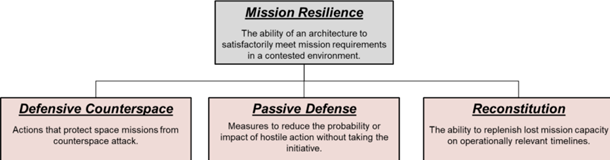
Figure 1: Mission Resilience Taxonomy
In a counterspace campaign against a peer adversary, the operational goal is to impose an unsustainable loss-exchange ratio. By layering active and passive defensive measures, we can force an adversary to expend a disproportionate amount of their limited counterspace arsenal for each successful kill. This severely degrades the overall effectiveness of their attack and, most critically, slows their tempo. Because an adversary's goal is not just to destroy satellites, but to disable a capability within a specific timeframe, this delay buys valuable time for joint and coalition forces to react and bring terrestrial fires to bear.
Achieving a favorable loss-exchange ratio is not merely a tactical challenge; it is fundamentally a matter of force design. To effectively fight through attrition, the Space Force must be structured to seamlessly integrate the capabilities of allies and commercial providers. These partnerships expand our aggregate capacity and complicate an adversary's targeting calculus, forcing them to expend resources against a much larger and more diverse set of assets. Simultaneously, our own force structure must prioritize adaptability. This requires an inventory capable of dynamic response, including satellites with enhanced maneuverability for deception and survival, software-defined payloads that can be repurposed on-orbit, and modular systems built on common standards for rapid augmentation. This marks a necessary shift in philosophy: efficiency can no longer be the dominant factor in our force structure. A force optimized solely for peacetime efficiency is inherently fragile and will shatter upon first contact with a determined adversary. The resilience required to be combat effective must be one of our new guiding principles.
10. Achieving space superiority requires deliberate campaigning.
The 2022 National Defense Strategy (NDS) presented campaigning as a framework for competition below the threshold of conflict. “Campaigning initiatives change the environment to the benefit of the United States and our Allies and partners, while limiting, frustrating, and disrupting competitor activities that seriously impinge on our interests, especially those carried out in the gray zone.”[17] In this approach, all elements of national power are deliberately operationalized and integrated during peacetime to achieve strategic objectives in the same manner disparate parts of the joint force are orchestrated to achieve military objectives in combat. This requires the Joint Force to engage in strategic competition by pursuing initiatives that strengthen military advantage, build partnerships, and address gray zone challenges.[18]The concept of campaigning for enduring advantage provides a useful structure for confronting adversarial gray zone activities below the threshold of conflict while creating the conditions that facilitate the achievement of space superiority should hostilities ensue. The assertion that space superiority requires campaigning strikes at how space forces must prepare for a counterspace fight.
First, counterspace campaigning must increase our decision advantage by expanding our knowledge of the operational environment. Activities like surveillance, reconnaissance, and target development are crucial for systematically understanding adversary systems, their tactics and dependencies, and their exploitable vulnerabilities. At the same time, space forces must take deliberate actions to counter or deny adversary attempts to understand the counterspace operating environment through activities like operational security, counter-reconnaissance, and military deception. Finally, on-orbit assets with maneuver capability can support intelligence preparation of the environment by “proactively prob[ing] adversary systems for vulnerabilities” and responses.[19] These types of campaigning activities should shape enemy perceptions of friendly capabilities and schemes of maneuver, while also building a better understanding of the enemy’s employment concepts.
Second, campaigning activities must build partner capacity and readiness for counterspace operations. A counterspace operation will be a global fight, making a worldwide collection of allies and partners indispensable to achieving space superiority. Campaigning initiatives like exercises and partner-nation training that build the proficiency, interoperability, and effectiveness of coalition counterspace operations will pay dividends in a conflict. Even partner nations without counterspace forces can still strengthen counterspace capabilities. The ability to position sensors, apertures, radars, downlink sites, and platforms in the territory of partner nations expands revisit rates associated with terrestrial-to-space effects in a conflict. It also provides survivability through resiliency, allowing space forces to effectively fight through attrition.
Third, counterspace campaigning must demonstrate U.S. resolve and capability. Large force counterspace exercises can signal the readiness of U.S. forces to gain and maintain space superiority. Show of force operations demonstrate national resolve through the increased visibility of U.S. combat capability. Tasking a maneuverable spacecraft to safely intercept and shadow a rival’s counterspace platform through a close approach with an allied satellite demonstrates that the United States has the resolve and capability to confront coercive behavior in the domain while simultaneously gathering valuable intelligence on adversary tactics and response protocols. Another way space forces can confront malign behavior is by overtly tracking rival spacecraft suspected of irresponsible, dangerous, or malign activities. Properly employed, these types of activities undermine the confidence our rivals have in their ability to conduct unattributed coercive actions and achieve objectives through military force while also creating responsiveness should open hostilities break out.
According to the 2022 NDS, the ultimate goal of campaigning is to enhance deterrence. It is crucial to remember, however, that deterrence is a political ideal, not a military objective.[20] Military forces contribute to deterrence by posturing to decisively prevail in a conflict – to attack, defend, and defeat an enemy through overwhelming force. A Space Force that is unambiguously prepared to conduct full-spectrum counterspace operations and achieve space superiority will strengthen the other components of military power in a way that our national leaders can use to create the conditions of deterrence.
Guardians Lead the Way
Space superiority is not a contest of technology, but a contest of wills and intellect. It is the deep expertise of the Guardian that provides the technical foundation for every action. It is their creativity and cunning that allows them to out-think an adversary, devise tactical solutions amid technical degradation, and turn the cold logic of orbital mechanics into an unpredictable operational art. Their audacity and willingness to take calculated risks and seize the initiative under pressure is what will, in the end, determine victory.
Empowering this human advantage, however, requires a common framework. Doctrinal debates over terms like operation, campaign, and campaigning can feel pedantic, but they are critical. As the primary advocates for space power, Guardians must use language that resonates across the Joint Force, ensuring our unique contributions are never misunderstood or underutilized. While the space domain requires new vocabulary, the syntax and grammar must be joint. By anchoring our concepts in shared doctrine, we ensure that the creativity and audacity of the warfighter can be fully integrated as a decisive component in any future fight. For space superiority is not an engineering problem to be solved; it is a human endeavor to be won.
References
[1] Joint Chiefs of Staff, Joint Publication 3-14, Joint Space Operations ([Washington, DC]: Joint Chiefs of Staff, August 23, 2023).
[2] Gen B. Chance Saltzman, “The Formative Purpose of the Space Force, CSO C-Note #8” (Washington, DC: U.S. Space Force, March 3, 2023), https://www.spaceforce.mil/Portals/2/Documents/CSO%20C-Notes/C-Note%208%20-%203%20Mar%2023%20--%20The%20Formative%20Purpose%20of%20the%20Space%20Force.pdf.
[3] Air Force capstone doctrine published in 2004 went so far as to explicitly acknowledge that achieving space superiority required military forces to attack on-orbit satellites; communication links; ground stations; launch facilities; command, control, communication, computer, intelligence, surveillance, and reconnaissance (C4ISRT) systems; and third-party providers. See Department of the Air Force, Basic Aerospace Doctrine of the United States Air Force, Air Force Manual 1-1, vol. 2 (Washington, DC: Department of the Air Force, March 1992) and Department of the Air Force, Counterspace Operations, Air Force Doctrine Document 2-2.1 (Washington, DC: Department of the Air Force, August 2, 2004).
[4] Department of the Air Force, Counterspace Operations, Air Force Doctrine Annex 3-14 (Washington, DC: Department of the Air Force, November 27, 2012).
[5] Les Aspin, Report on the Bottom-Up Review (Washington, DC: Department of Defense, October 1993), 9.
[6] William S. Cohen, Report of the Quadrennial Defense Review (Washington, DC: Department of Defense, May 1997).
[7] Cohen, Report of the Quadrennial Defense Review. Aspin, Report on the Bottom-Up Review.
[8] Aspin, Report on the Bottom-Up Review.
[9] Cohen, Report of the Quadrennial Defense Review.
[10] Cohen, Report of the Quadrennial Defense Review, 17.
[11] Cohen, Report of the Quadrennial Defense Review, 17.
[12] Joint Chiefs of Staff, Joint Publication 3-0, Joint Operations ([Washington, DC]: Joint Chiefs of Staff, June 18, 2022), I-2. Among doctrinaires, the use and misuse of the term campaign creates emotional distress. Following Desert Storm, Air Force leadership celebrated the decisiveness of the 42-day Air Campaign that opened the conflict. Army leadership, on the other hand, viewed the air campaign terminology used by Air Force Generals Dugan and McPeak as a cleverly designed marketing scheme to portray airpower as unilaterally decisive to the public. Instead, from the soldiers’ perspective, Desert Storm was a combined-arms campaign that opened with an air operation that supported decisive land action. Thirty-five years later, joint doctrine has sided with the Army. See Merrill A. McPeak, Roles and Missions (Washington, DC: Lost Wingman Press, 2017), 25.
[13] Joint Chiefs of Staff, Joint Operations, III-4.
[14] Carl von Clausewitz made this point clear in On War when he noted that: “Defense in general (including of course strategic defense) is not an absolute state of waiting and repulse; it is not total, but only passive endurance. Consequently, it is permeated with more or less pronounced elements of the offensive. In the same way, the attack is not a homogenous whole: it is perpetually combined with defense.” See Carl von Clausewitz, On War, ed. and trans. Michael Howard and Peter Paret (Princeton, NJ: Princeton University Press, 1984), 524.
[15] For example, in the context of space superiority, cyber forces could take offensive action against an adversary’s space domain awareness enterprise to defend an ISR satellite that is providing targeting data for offensive strikes against enemy forces to defend against adversary aggression.
[16] In so doing, friendly space forces must seek “to diminish [an] adversary's capacity to adapt while improving our capacity to adapt as an organic whole, so that our adversary cannot cope while we can cope with events/efforts as they unfold.” See Frans P. B. Osinga, Science, Strategy and War: The Strategic Theory of John Boyd (London: Routledge, 2007), 237. The type of decision advantage winning the battle for SDA affords is a critical element of warfare in every domain. The current Marine Corps concept of operations describes the Reconnaissance and Counter-reconnaissance Battle as a key element of modern maritime warfare, noting that the end goal of these efforts is “to provide the fleet commander an advantage in situational awareness relative to an adversary at every point on the competition continuum.” See U.S. Marine Corps, A Concept for Stand-in Forces (Washington, DC: Headquarters, U.S. Marine Corps, December 2021), 11, https://www.hqmc.marines.mil/Portals/142/Users/183/35/4535/211201_A%20Concept%20for%20Stand-In%20Forces.pdf. Similarly, the Army’s concept of operations for multi-domain operations elevates decision advantage by adding a line of effort that directly addresses Information Environment Operations designed to “degrade, disrupt, or destroy threat capabilities that inform or influence decision making” and “protect friendly information, technical networks, and decision-making capabilities from an exploitation by adversary/enemy information warfare assets.” Winning the battle for SDA is the counterspace equivalent to these operational imperatives. See U.S. Army Training and Doctrine Command, The U.S. Army in Multi-Domain Operations 2028, TRADOC Pamphlet 525-3-1 (Fort Eustis, VA: U.S. Army Training and Doctrine Command, December 6, 2018), 74, https://api.army.mil/e2/c/downloads/2021/02/26/b45372c1/20181206-tp525-3-1-the-us-army-in-mdo-2028-final.pdf.
[17] U.S. Department of Defense, 2022 National Defense Strategy of the United States (Washington, D.C.: Department of Defense, 2022), 12, https://media.defense.gov/2022/Oct/27/2003103845/-1/-1/1/2022-NATIONAL-DEFENSE-STRATEGY-NPR-MDR.PDF.
[18] Kathleen H. Hicks et al., By Other Means: A Gray Zone Deterrence Strategy (Washington, DC: Center for Strategic and International Studies, 2019), https://csis-website-prod.s3.amazonaws.com/s3fs-public/publication/Hicks_GrayZone_interior_v4_FULL_WEB_0.pdf.
[19] Mark F. Cancian, “The U.S. Joint Chiefs’ New Strategy Paper: Joint Concept for Competing,” Center for Strategic and International Studies, June 11, 2019, https://www.csis.org/analysis/us-joint-chiefs-new-strategy-paper-joint-concept-competing.
[20] Gen B. Chance Saltzman, “Remarks by CSO Gen. Chance Saltzman at the 2024 Global Air and Space Chiefs’ Conference,” U.S. Space Force, July 16, 2024, https://www.spaceforce.mil/News/Article-Display/Article/3841700/remarks-by-cso-gen-chance-saltzman-at-the-2024-global-air-and-space-chiefs-conf/.
Disclaimer:
The views and opinions expressed in this paper are solely those of the author and do not reflect the official policy, position, or endorsement of the Department of War, the United States Space Force, or any other agency of the U.S. Government.