
Position Paper on Mining in Outer Space
POSITION PAPER
ON
MINING IN OUTER SPACE
1. For 40,000 years, mankind has mined the resources of planet Earth for all manner of purposes: weapons, tools, objects for trade, and national currency.[1] In fact, mining has had such a profound impact on human history that entire eras are named after the discovery and use of mined materials: the Stone Age, the Bronze Age, and the Iron Age. Even in the more modern period, it has powered and furthered the Industrial Revolution, such as the acquisition of coal and steel.[2] Mining has been a cornerstone of human development, and this paper will serve to argue that not only should mining continue into outer space as technology advances, but even in areas where current treaties may not accept certain claims (e.g., sovereignty over asteroids), those treaties should be amended or rescinded entirely to allow for such an action in pursuit of national interest.
Section I: The Benefits of Space Mining
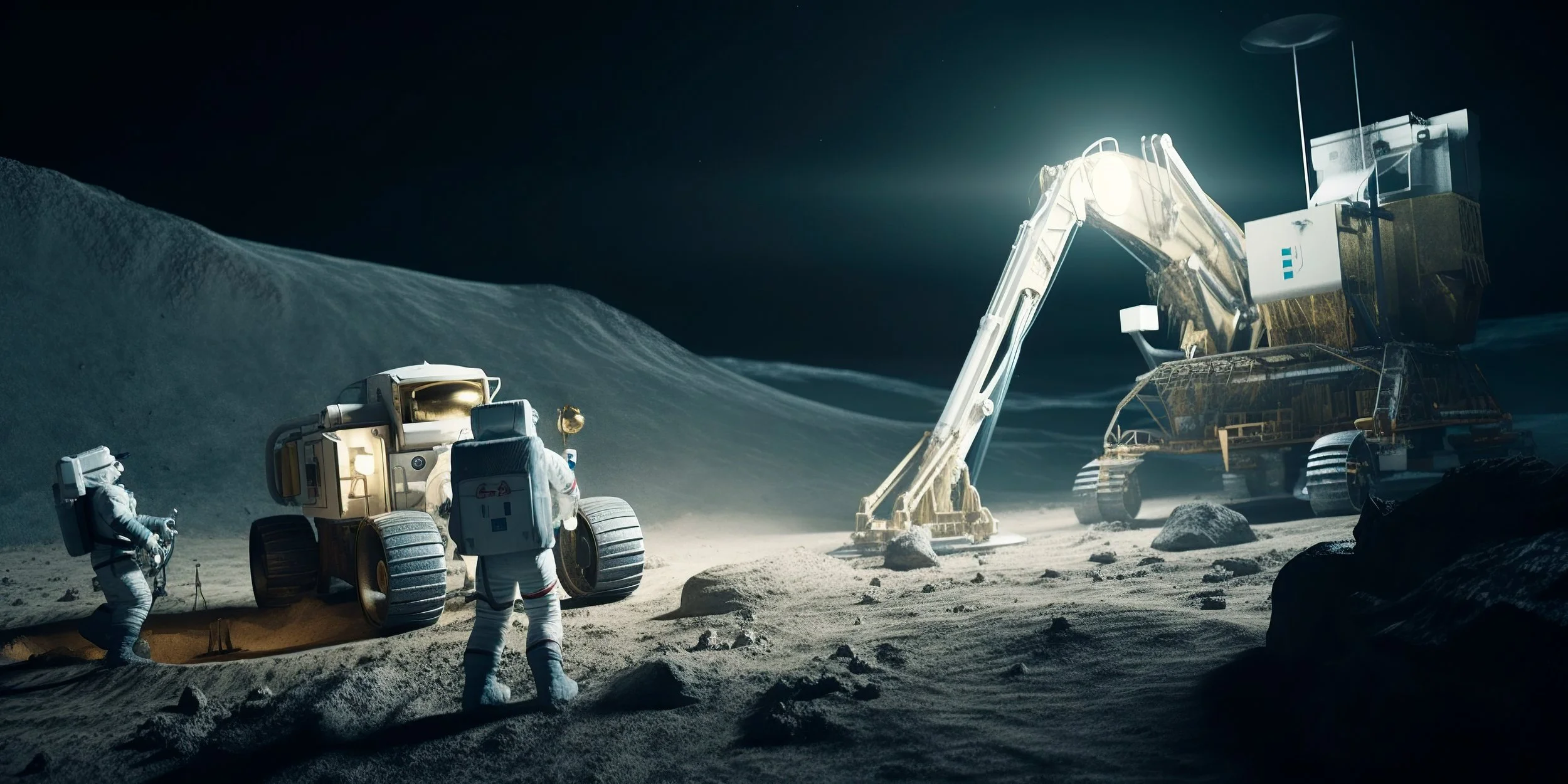
2. The idea of mining in outer space goes back a full 128 years, from the publication of the novel Edison’s Conquest of Mars, which depicted Martians mining gold from asteroids.[3] Later, in the 1940s, Isaac Asimov’s short story Catch That Rabbit introduced the concept of robotic mining, specifically by an anthropomorphic machine.[4] From the 1950s onward, humanity ceased discussing space mining in fictional terms and began looking at the topic from a scientific perspective.[5] Current advancements in the technology of mining in outer space include autonomous rovers that can use laser-based spectroscopy to identify metals[6]; multifunctional robots capable of drilling, scooping, anchoring, and maneuvering on low-gravity surfaces[7], swarm robotics for asteroid operations, which, as an entire fleet of small autonomous machines, can map, drill, collect samples, and transport materials more efficiently than a single large robot.[8]
3. Outer space is a cruel environment, and, as such, the requirements for machinery that endure and succeed in this sort of setting will be equally as strenuous. The good news is that the rewards for pursuing mining in outer space will be immense, possibly even immeasurable. For example, one Near-Earth asteroid, Asteroid 1986 DA, is estimated to have $10-12T worth of resources in it, containing metals such as iron, nickel, and cobalt.[9] Now, there are limitations to using such metals, as selling all of them upon return to Earth will simply crash prices, which the law of supply and demand dictates. Nonetheless, having these sorts of metals on hand will give assurance, for decades if not centuries on end, of a readily available supply of resources to be used in the manufacture of devices used on a regular basis by Americans.
4. When this writer mentions the repetitive use of devices based on these metals, that is no exaggeration. Cobalt, for example, has an important function in the batteries of nearly all smartphones, stabilizing the cathode and preventing the battery from overheating.[10] Nickel, along with being also found in the batteries of cell phones, is used in the production of stainless steel, which in turn is utilized, for example, in the creation of construction materials, medical instruments, and kitchen equipment.[11] It’s even used in marine and offshore engineering, as nickel has excellent resistance to seawater corrosion.[12]
5. While the economic implications of mining in outer space are monumental, the ripple effects of this possible industry in the realm of geopolitics, specifically regarding the current strategic competition between the United States and China, are no less significant. In 2024, for example, 80% of American consumption of rare earth metals came from imports, 77% of which came from China.[13] The issue has become even more serious lately, as in April 2025 China restricted the exports of seven of these rare earths, all of which are used in our defense, energy, and automotive industries.[14] This, in turn, is where the issue of asteroid mining becomes paramount, as all seven of these metals, and all seventeen of the rare earth elements which currently exist and which we import from China, are found on Near-Earth asteroids.[15] There is simply no way to measure how massive the implications of rare earth element self-sufficiency will be regarding our rivalry with the Chinese regime, specifically as it relates to the two countries’ struggle for influence in East Asia.
6. Even in the Atlantic sphere the implications will be profound. The issue of Greenland’s possible annexation by the United States, by force or otherwise, has recently had a notable negative impact on relations between America and Europe. One reason that Greenland has become so important is that it, like China, contains both rare earth and other critical minerals.[16] Being able to mine all seventeen of the rare earth elements on asteroids negates the American need for Greenland’s mineral resources entirely, as even the island’s critical minerals, such as platinum-group metals,[17] are found on Near-Earth Asteroids.[18] This in turn will do much to ease cross-Atlantic tensions over the fate of this region.
7. Another relevant factor regarding mining in outer space is the isotope known as helium-3. This gas is currently used, among other areas, in two high-priority emerging technologies: nuclear fusion and quantum computing.[19] For example, helium-3 enables quantum computing to possess greater energy efficiency and faster machine problem solving in areas such as cryptography and data-modeling.[20] Like the seventeen rare-earth elements, this isotope is also extremely uncommon on our planet, but quite common elsewhere, in this case on the Moon itself. In 2024, the United States imported $23.5M worth of helium-3, 95% of it coming from Canada.[21] Similar to the issue of Greenland’s future, mining helium-3 on the Moon will lessen tensions with our northern neighbor, with whom we are currently locked in a series of trade disputes.
8. Put simply, there are massive economic and geopolitical ramifications to engaging in mining in outer space, ramifications that will enhance our national security, boost the economy, and thus positively affect the lives of everyday Americans.
Section II: The Legalities of Space Mining
9. The United States is currently party to four of the five treaties that exist relating to outer space. The first and most important is the Outer Space Treaty of 1967 (hereafter to be referred to as the OST), and the second, third, and fourth treaties are the Rescue Agreement of 1968, the Liability Convention of 1972, and the Registration Convention of 1976, respectively. The fifth treaty, to which neither the United States nor any other major spacefaring country is party, is the Moon Agreement of 1984 (hereafter to be referred to as MOON). This next section will explore the OST and MOON as it relates to space resource extraction, along with pertinent domestic laws, presidential executive orders, and the Artemis Accords.
10. The OST was ratified at a high point of the Cold War, only four years removed from a near nuclear holocaust involving the USSR over the Cuban Missile Crisis. With this backdrop, the United States, the USSR, and their respective allies came to an agreement over how to treat each other in outer space with the aim of avoiding future conflict.[22] This is especially evident in Article [23], which bans the placement of nuclear weapons in outer space, but also is evident in Article II, which prevents ‘national appropriation’ of any part of outer space, thereby banning the annexation of the Moon, any smaller portion of it, or any other celestial body.[23] Specifically, this means that no country can claim any asteroid as its own, no matter the expense or risk to human life that was required to reach that body, nor how valuable such an entity may be. The implication of this provision is deeply serious, signifying that even if America reaches an asteroid that contains metals worth a truly astronomical sum, it cannot prevent another country from also landing upon the asteroid to begin its own mining operations, thereby bringing profit to its own people. Lastly, Article VI states that countries are not only responsible for national activities in outer space, be they of the public or private sector, but that those actors must have governmental permission to operate there to begin with. Notably, the Article and the Treaty are silent on the matter of what must be done with any resources that a nation or a nation’s private sector acquires.
11. MOON has not had nearly the same level of acceptance as the OST, for reasons that will be clear imminently. As of 2026, twenty-one countries are parties or signatories to the treaty[24], and only three of these countries have an active space program.[25] What MOON states, specifically in paragraph 1 of Article 11, is that the Moon and its resources are “the common heritage of mankind,” which means that no nation can claim either its resources or profits therefrom for themselves.[26] In legal terms, public property is known as res communis. A more colloquial term would be ‘the commons.’ MOON’s provisions matter because if the United States were to ratify the treaty, it would be forced to share any helium-3, other resources, and the profits from those resources with every nation on Earth, even if those countries had zero role in spending the money and effort required to get those resources. For this reason alone, the U.S. Congress rejected the treaty as unfavorable to national interest.[27] The reason MOON is relevant at all is that if these three countries (France, India, and Australia) ever establish a lunar mining industry, this could lead to some level of discord between our country and theirs.
12. In 2015, Congress went very much in the opposite direction of MOON, passing a law, signed thereafter by President Obama, called the Commercial Space Launch Competitiveness Act.[28] This law allows private companies and individuals to engage in commercial exploitation of all resources in space, although even in this statute, its authors took care to stipulate, in light of the OST, that “the United States does not [by this Act] assert sovereignty, or sovereign or exclusive rights or jurisdiction over, or the ownership of, any celestial body.”[29] Therefore, even under this law, the United States must share any asteroid that it lands upon, along with the Moon and other planets, with any nation that also arrives there.
13. In 2020, President Trump signed Executive Order 13914, “Encouraging International Support for the Recovery and Use of Space Resources,” which, among other actions, categorically rejects MOON and the idea of outer space as a global commons, and explicitly affirms the idea that Americans have the right to use resources in space for private profit.[30] Although this executive order does not contravene the OST regarding annexing any celestial body, what it does do is make even more explicit than in Article VI of the aforementioned treaty that mining in space by the private sector is most certainly in the national interest, and that Americans are not required to share those resources with any foreign entity.
14. Also in the year 2020, the United States along with seven other countries (now numbering a total of 61 as of 2026) signed the Artemis Accords, with the purpose of elaborating “a practical set of principles, guidelines, and best practices to enhance the governance of the civil exploration and use of outer space….”[31] Although not legally binding, this number of nations (13 of whom are spacefaring) committing to these principles represents an important step forward in establishing norms of behavior outside of our atmosphere. Notably, Section 10 of the Accords stipulates that extraction of space resources does not constitute national appropriation and, therefore, does not violate Article II of the OST.[32]
15. In summary, the treaties and laws pertaining to how the United States and the bodies therein (including the U.S. Space Force) treat outer space span several decades and have direct impact on how our country is expected by the international community to conduct itself, specifically but not limited to the realm of mining in outer space.
Section III: Recommendations and Conclusion
16. As stated in Section I, the positive economic and geopolitical ramifications of asteroid and lunar mining are either immeasurable or nearly so. The American people stand to gain from a status quo where the Chinese regime is unable to use rare earth elements as leverage in a trade dispute, and if tensions with China escalate into full-scale war, our supply chain for key armaments will not be threatened by the Chinese refusing to send us further supplies. Furthermore, the chances of us being at odds with our European allies will lower dramatically if we no longer need the island of Greenland for any of its mineral resources. Lastly, the long-term economic ripple effects of having trillions, if not quadrillions or quintillions of dollars’ worth of minerals in our reserves effectively guarantees the prosperity of the American people for centuries to come.
17. Regarding the legalities of space mining as reviewed in Section II, the situation is not as straightforward. This author firmly supports either renegotiating the OST or pulling out of the treaty entirely, as the treaty unequivocally bans wholesale the annexation of asteroids, which goes against our national interest. The reason for this is that having to share an asteroid, after investing the tremendous amount of time, effort, and money that it would require to reach said body, would shortchange the American people dramatically. Given the worth of any given asteroid, having to share it, even after getting there first, would mean losing out on at least trillions of dollars that could otherwise benefit our fellow citizens. Now, a natural rebuttal to this argument is that with so much value on even a single asteroid, there is more than enough profit to go around, and therefore there is no compelling reason to prevent anyone else sharing in the prosperity that would inevitably come from asteroid mining. The counter to this perspective, at least from the standpoint of offensive realism, is that national strategy is not about simply maximizing one’s own country’s interests but also negating the interests of rival powers. In his book The Tragedy of Great Power Politics, Professor (and former Air Force officer) John Mearsheimer writes: “Great powers recognize that the best way to ensure their security is to achieve hegemony now, thus eliminating any possibility of a challenge by another great power.”[33]
18. More than a few national strategists would consider this viewpoint cynical and narrowminded, preferring the approach of liberal institutionalism, which is based on the idea that geopolitics is and should be a positive-sum approach, based on mutual trust and cooperation.[34] The flaw in this thinking is that China is not a country that can even remotely be trusted to act in a fair and evenhanded manner, as evidenced by their recent history of deeply underhanded and unethical behavior. For example, in 2022, the U.S. Department of Justice reported that 80% of its economic espionage cases come from the People’s Republic of China,[35] and the Australian Institute of International Affairs has reported that not only does China engage in trade-distortive policies, but that China subsidizing its industries to undercut foreign prices accounted for 95% of all its trade-distortive policies between 2009 and 2022.[36] Another example would be China’s claims in the South China Sea, which are so extensive that the World Court at the Hague has ruled against these arbitrary policies, stating that such claims violate Philippine sovereignty.[37] China has rejected the Hague’s ruling entirely.[38] For these reasons alone, China must be rejected as any kind of trustworthy partner, since if they are not behaving ethically and reliably here on Earth, there is no reason to believe that they will do so in the far reaches of space.
19. Regarding the Moon and the legalities that go along with our treatment of said body, the situation is much the same as with asteroids, with one important difference. Unlike the average asteroid, the Moon is a relatively large body, larger than the continent of Africa in terms of surface area.[39] Claiming such a large area, and enforcing such claims, would be a challenge even for our country as the reigning superpower. Given this reality, it is far better to content ourselves with mining certain portions of the Moon, enforcing boundaries in the same way we enforce property lines and national borders here on Earth. As with asteroids, it is indeed better to stake exclusive claims to certain portions, if only to prevent China from sharing in them. In fact, the distribution of helium-3, for example, is not evenly spread across the Moon. Regions such as Oceanus Procellarum and Mare Tranquillitatis (the site of the original Moon landing) have relatively high concentrations of the isotope[40] and are significantly easier to secure for American interests than the Moon in its entirety. Annexing even these smaller portions of the Moon, however, as with claiming asteroids for the country, would violate Article II of the OST, and therefore provides even more reason to amend or pull out of this 59-year-old treaty.
20. In conclusion, space mining is the way of the future for any country willing to commit to the hard work of creating a resource-gathering infrastructure in outer space. Space mining will bring about tremendous national prosperity, enhance our geopolitical standing with our adversaries, and lessen political and trade tensions between ourselves and our allies. Furthermore, it is long past time to renegotiate or withdraw from the OST, an outdated agreement that will only allow our adversaries to gain advantages and profits that could be otherwise denied to them. America has been the greatest power on Earth for 80 years; pursuing space mining will be a key factor in allowing us to remain so for significantly longer.
REFERENCES
[1] “Metallurgy Through the Ages,” Encyclopedia.com, accessed January 29, 2026, https://www.encyclopedia.com/science/encyclopedias-almanacs-transcripts-and-maps/metallurgy-through-ages.
[2] Troy Vettese, “History of Energy from 1850 to 1900,” EBSCO Research Starters, accessed January 29, 2026, https://www.ebsco.com/research-starters/power-and-energy/history-energy-1850-1900.
[3] “Brief History of Space Mining,” Beyond Earth Mining, accessed January 29, 2026, https://www.beyondearthmining.com/history-of-space-mining.html.
[4] “Brief History”
[5] “Brief History”
[6] Isaiah Richard, “Space Mining Technologies: How Robotic Prospecting Missions Unlock Extraterrestrial Resources,” TechTimes, December 22, 2025, https://www.techtimes.com/articles/313539/20251222/space-mining-technologies-how-robotic-prospecting-missions-unlocks-extraterrestrial-resources.htm.
[7] “The History of Mining: From the Stone Age to the Digital Age,” AZoMining, April 29, 2025, https://www.azomining.com/Article.aspx?ArticleID=1859.
[8] “Robot Swarms Mine Asteroids in 2026: The Future of Space Mining,” Science Array, accessed January 29, 2026, https://space.sciencearray.com/robot-swarms-mine-asteroids-2026-space-mining.
[9] Loukia Papadopoulos, “A Nearby Asteroid Contains More Than $11 Trillion in Precious Metals,” Interesting Engineering, December 22, 2023, https://interestingengineering.com/science/a-nearby-asteroid-contains-more-than-11-trillion-in-precious-metals.
[10] Alsym Energy, “Cobalt Has No Place in Modern Batteries — Here’s Why,” Alsym Energy [blog], August 9, 2022, https://www.alsym.com/blog/cobalt-has-no-place-in-modern-batteries-heres-why.
[11] “Top 10 Uses of Nickel in Industries,” Vision Alloys [blog], November 18, 2024, https://www.visionalloys.com/blog/top-10-uses-of-nickel-in-industries.
[12] “Top 10 Uses.”
[13] Jack Caporal, “Rare Earths Trade Statistics: U.S. Sources and Import Reliance,” The Motley Fool, accessed January 29, 2026, https://www.fool.com/research/rare-earths-trade-statistics.
[14] Roopashree Sharma, “China Restricts Export of 7 Rare Earth Minerals: Check Full List and Their Uses Here,” Jagran Josh, last modified April 22, 2025, https://www.jagranjosh.com/general-knowledge/china-restricts-export-of-rare-earth-minerals-check-full-list-and-their-uses-1745319766-1.
[15] Marc Kaufman, “Metal Mini-Asteroids Detected Passing Near Earth, Offering Potentially Great Science — and Maybe Future Mining,” Many Worlds, November 3, 2021, https://manyworlds.space/2021/11/03/metal-mini-asteroids-detected-passing-near-earth-offering-potentially-great-science-and-maybe-future-mining.
[16] Kevin Collier, “Greenland’s Rare Earth Minerals Could Be a Game Changer,” NBC News, April 6, 2024, https://www.nbcnews.com/tech/innovation/greenland-rare-earths-critical-minerals-rcna254177.
[17] Geological Survey of Denmark and Greenland (GEUS), “Critical Raw Materials Map,” accessed April 2, 2026, https://data.geus.dk/geusmap/?mapname=critical_raw_materials.
[18] S. K. Haldar, “Critical Minerals: A Global Perspective,” Mineral Economics (2024), https://link.springer.com/article/10.1007/s13563-024-00429-y.
[19] Marcin Frąckiewicz, “Mining the Moon’s Helium‑3: The Key to a Quantum Computing and Energy Revolution,” TechStock2, September 17, 2025, https://ts2.tech/en/mining-the-moons-helium-3-the-key-to-a-quantum-computing-and-energy-revolution.
[20] James D. Halderman, “Helium: The Quantum Computing Coolant Facing Supply Risks,” The Qubit Report, March 25, 2025, https://posts.thequbitreport.com/quantum-computing-technology-and-hardware/2025/03/25/helium-the-quantum-computing-coolant-facing-supply-risks.
[21] “Helium-3 in United States” [Trade Profile], Observatory of Economic Complexity (OEC), accessed January 29, 2026, https://oec.world/en/profile/bilateral-product/helium-3/reporter/usa.
[22] Donald A. Watt, “Outer Space Treaty Takes Effect,” EBSCO Research Starters, 2023, https://www.ebsco.com/research-starters/history/outer-space-treaty-takes-effect.
[23] U.S. Department of State, “Treaty on Principles Governing the Activities of States in the Exploration and Use of Outer Space, Including the Moon and Other Celestial Bodies,” accessed January 29, 2026, https://2009-2017.state.gov/t/isn/5181.htm.
[24] A signatory is a country whose ambassador has signed said agreement, but the country never ratified it and is therefore not bound to said accord.
[25] An active space program is defined as having at least one of the following: independent launch capability, active planetary or lunar missions, major satellite manufacturing, significant space science infrastructure, or a notable space budget.
[26] United Nations Office for Outer Space Affairs, “Agreement Governing the Activities of States on the Moon and Other Celestial Bodies (Moon Agreement),” accessed January 29, 2026.
[27] U.S. Congress, Senate, Subcommittee on Science, Technology, and Space of the Committee on Commerce, Science, and Transportation, Hearings before the Subcommittee on Science, Technology, and Space of the Committee on Commerce, Science, and Transportation, 96th Cong., 2nd sess., (1980).
[28] U.S. Congress, House, H.R. 2262, U.S. Commercial Space Launch Competitiveness Act, 114th Cong., 2015, https://www.congress.gov/bill/114th-congress/house-bill/2262.
[29] U.S. Congress, H.R. 2262.
[30] Executive Office of the White House, “Executive Order on Encouraging International Support for the Recovery and Use of Space Resources,” April 6, 2020, https://trumpwhitehouse.archives.gov/presidential-actions/executive-order-encouraging-international-support-recovery-use-space-resources.
[31] NASA, The Artemis Accords: Principles for Cooperation in the Civil Exploration and Use of the Moon, Mars, Comets, and Asteroids for Peaceful Purposes, October 13, 2020, https://www.nasa.gov/wp-content/uploads/2022/11/Artemis-Accords-signed-13Oct2020.pdf.
[32] NASA, The Artemis Accords.
[33] John J. Mearsheimer, The Tragedy of Great Power Politics (New York: W. W. Norton, 2001), 140.
[34] “Liberal Institutionalism,” Fiveable, accessed January 29, 2026, https://fiveable.me/key-terms/introduction-international-relations/liberal-institutionalism.
[35] Ellen Nakashima, “Justice Dept. Ends Trump-Era ‘China Initiative,’ Launches Broader Strategy to Counter Nation-State Threats,” The Washington Post online, February 23, 2022, https://www.washingtonpost.com/national-security/2022/02/23/china-initivative-redo.
[36] Stewart Paterson, “It’s You, Not Me: China’s Subsidies and Global Trade Tensions,” Australian Outlook (Australian Institute of International Affairs), July 25, 2023.
[37] Susan V. Lawrence, South China Sea Arbitration Ruling: What Happened and What’s Next [Issue Brief] (Washington, DC: U.S.–China Economic and Security Review Commission, July 12, 2016), https://www.uscc.gov/sites/default/files/Research/Issue%20Brief_South%20China%20Sea%20Arbitration%20Ruling%20What%20Happened%20and%20What's%20Next071216.pdf.
[38] Danson Cheong, “China Says It Does Not Accept Philippines’ 2016 South China Sea Arbitration Win,” The Straits Times, updated November 18, 2024, https://www.straitstimes.com/asia/se-asia/china-says-it-does-not-accept-philippines-2016-south-china-sea-arbitration-win.
[39] Jamie Carter, “Is Africa Bigger Than the Moon?” Scope the Galaxy [blog], July 18, 2023, https://scopethegalaxy.com/is-africa-bigger-than-the-moon.
[40] Kronos Fusion Energy, “Helium‑3 on the Moon: A Case Study,” LinkedIn [article], October 20, 2023, https://www.linkedin.com/pulse/case-study-helium-3-extraction-moon-strategic-analysis.
Disclaimer:
The views and opinions expressed in this paper are solely those of the author and do not reflect the official policy, position, or endorsement of the Department of War, the United States Space Force, or any other agency of the U.S. Government.